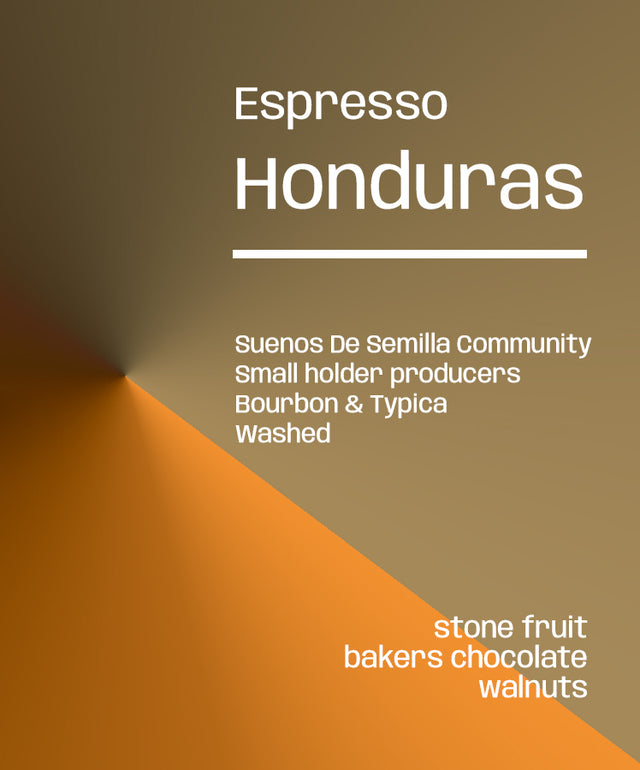
Honduras Suenos De Semilla - Espresso
Honduras Suenos De Semilla - Espresso
Thank you Semilla coffee for introducing us to some amazing lots from Honduras, This is the first time we have had a Honduran coffee on our offer list and couldn't be happier!
******************************************************
- Producers + Mill:
More info coming soon!
Semilla have also provided us with the prices paid at farm level:
Farmgate price:
17,000 Lempira/carga parchment.
Regional farmgate price (2026):
14,000 Lempira/carga parchment.
FOB Price: $4.51 USD/lb
******************************************************
- Varieties:
Villa Sarchi - Like Caturra and Pacas, Villa Sarchi (also called La Luisa or Villalobos Bourbon) is a natural mutation of a Bourbon population with a single-gene mutation that causes the plant to grow smaller (called “Dwarf/Compactism’). The variety was discovered in Costa Rica in the 1950s or 1960s in the northwestern region of the province of Alajuela, and has subsequently undergone pedigree selection (selection of individual plants through successive generations) there. It is not widely grown outside Costa Rica, though was introduced to Honduras in 1974 by IHCAFE.It is known for being well-adpated to the highest altitude conditions and tolerant of strong winds.Villa Sarchi is perhaps most well known as one of the namesakes of the “Sarchimor” group of coffees.
Parainema - Well-adapted to medium altitudes, resistant to coffee leaf rust and some nematodes.
Yield and rust resistance for this variety were globally evaluated at 23 sites in 15 countries as part of WCR’s International Multilocation Variety Trial. A variety's local performance may vary based on which races of rust are present in the environment. Nematodes: Not resistant to Pratylenchus spp. Is resistant to some Meloidogyne spp.
Typica is the most famous of the Typica-descended varieties. It is a tall variety characterized by very low production, susceptibility to the major diseases, and good cup quality.The Typica group, like all Arabica coffee, is supposed to have originated in southwestern Ethiopia. Sometime in the 15th or 16th century, it was taken to Yemen. By 1700, seeds from Yemen were being cultivated in India. In 1696 and 1699, coffee seeds were sent from the Malabar coast of India to the island of Batavia (today called Java in Indonesia). These few seeds were the ones to give rise to what we now know as the distinct Typica variety. In 1706 a single Typica coffee plant was taken from Java to Amsterdam and given a home in the botanical gardens; from there, a plant was shared with France in 1714.From the Netherlands, Typica was sent in 1719 on colonial trade routes to Dutch Guiana (now Suriname) and then on to Cayenne (French Guiana) in 1722, and from there to the northern part of Brazil in 1727. It reached southern Brazil between 1760 and 1770. From Paris, plants were sent to to Martinique in the West Indies in 1723.
The English introduced Typica coffee from Martinique to Jamaica in 1730. It reached Santo Domingo in 1735. From Santo Domingo, seeds were sent to Cuba in 1748. Later on, Costa Rica (1779) and El Salvador (1840) received seeds from Cuba.In the late eighteenth century, cultivation spread to the Caribbean (Cuba, Puerto Rico, Santo Domingo), Mexico and Colombia, and from there across Central America (it was grown in El Salvador as early as 1740). Until the 1940s, the majority of coffee plantations in South and Central America were planted with Typica. Because Typica is both low yielding and highly susceptible to major coffee diseases, it has gradually been replaced across much of the Americas, but is still widely planted in Peru, the Dominican Republic, and Jamaica, where it is called Jamaica Blue Mountain.
******************************************************
- Process:
Cherries are harvested at peak ripeness, floated and then de-pulped on the same day. The de-pulped coffee is dry fermented in
concrete tanks or plastic barrels, under shade. Coffee is then washed in clean water and dried on raised beds or inside solar dryers for an
average of 25 days
******************************************************
- Region: San Juanillo, Las Botijas, Las Delicias, Encinal, Las Peñas
- Producer: Small Holder producers
- Importer: Semilla
- Price (green ex Shipping): £9.70p kg
- Varieties: Typica, Parainema and Villa Sarchi
- Process: Washed Process
- Altitude: 1350-700masl
- Amount Bought: 345kg
- Tasting: Choco, nutty, balanced, medium acidity, full body
- Flavours like: Stone fruit, bakers chocolate, walnuts
Manage Subscriptions
Log in here to manage your current Lucid subscription!