Ecuador Mitad El Mundo - Espresso
Ecuador Mitad El Mundo - Espresso
******************************************************
- Producers + Mill:
Mitad del Mundo, which translates to "Middle of the World," is a blend of coffees grown in Ecuador. Although Ecuador is a small country, it is rich in diversity and landscapes, ranging from the Amazon jungle to the stunning Andean highlands where coffee is produced. In addition to its beautiful culture and traditions, Ecuador is renowned for its high-quality, delicious coffees.
The Equator crosses the country, dividing it in half—one half in the Northern Hemisphere and the other in the Southern Hemisphere. This specific lot from Mitad del Mundo is sourced from the Southern Hemisphere, particularly from the region of Loja. In Loja, coffee production benefits from favorable altitude, climate, flora, fauna, and the region's beautiful, fertile mountains. The environment in which this coffee is grown creates a flavor profile that features notes of cacao and various fruits.
Coffee in Ecuador symbolizes the hard work and individual achievements of smallholders, who have made coffee their primary source of income and a significant employment generator in many regions.
The producers involved in Mitad del Mundo are not solely dedicated to coffee cultivation; they also engage in supplementary activities like cattle farming for milk and meat, which enhances their livelihoods. This deep-rooted passion for coffee has been passed down through generations, creating a legacy that connects them to their land. While they draw on traditional knowledge inherited from their parents, these producers actively seek improvements, continually learning to enhance the quality of their coffee.
Mindful of their environmental footprint, the producers adopt sustainable practices that protect local water sources and foster biodiversity on their farms. Each coffee farm is carefully shaded and managed within agroforestry systems, integrating crops such as guabos and porotillos that contribute to nitrogen fixation in the soil.
The region’s tropical climate, characterized by humidity and the unique soil of the Andes, provides ideal conditions for specialty coffee production. The area typically experiences a dry climate, with rainfall concentrated between March and May and sporadic showers throughout the year. While coffee production occurs year-round, the peak harvest season falls between June and August.
Since establishing a relationship with local producers in 2018, Peca has introduced innovative fermentation techniques that vary from 24 hours to as long as 100 hours. The coffee varieties cultivated in this area include Bourbon, Improved Typica, Caturra, and Sachimor, with most producers opting for the washed processing method.
******************************************************
- Variety:
Bourbon - The Bourbon coffee variety dates back to the 1700s when French missionaries first introduced it on Bourbon Island in the Indian Ocean. The island is called Réunion today and the missionaries moved on to Latin America in the middle of the 1800s. It was first grown in Brazil around 1860 and cultivation spread from there throughout Latin America. Because the standard Bourbon variety is susceptible to coffee leaf rust, it does best at higher altitudes at or above 1,800 meters where leaf rust is less likely to occur. Bourbon produces a tall coffee plant, excellent coffee, and medium to low production. It much of Latin America, basic Bourbon has been replaced by offshoots such as Caturra, Catuai, and Mundo Novo.
Caturra - This variety originated in Minas Gerais, Brazil. It is a natural mutation of Red Bourbon. Caturra produces more coffee and is more resistant to plant diseases than Bourbon.
Typica (also Tipica) forms the genetic backbone of much of specialty coffee today. The first coffee plantations grown in America and Asia were of the Typica variety and many of the most widely cultivated C. arabica crops today are descended directly from the plant.
In general, Typica is very similar in appearance to the Bourbon plant (of which it is a very close relative) although it has fewer secondary branches and the leaves are normally smaller than those of Bourbon. It is usually identifiable by its bronze leaf tips. The plants are tall (3.5 – 4m) and the berries have an elongated, oval shape.
Even though Typica has a relatively low yield it is known to produce coffee with high cup quality. It is, however, very susceptible to diseases and is becoming increasingly less common for this reason. (Info source: Mercanta)
******************************************************
- Process
The coffee producers in Loja, Pichincha and Zamora Chinchipe follow meticulous processes to ensure the quality of their coffee. All three regions begin with a manual, selective harvest of ripe cherries, often employing trained local individuals to identify the cherries ready for picking. In Alambi, the harvested cherries are taken to the on-farm wet mill for pulping, while producers in Zumba hire cherry pickers for this task. Following pulping, a fermentation process occurs, which varies in duration from 24 to 100 hours depending on the specific practices of the producers.
In Alambi, coffee fermentation takes place in closed, airtight containers, with some producers choosing to use water while others do not. They monitor the pH of the fermentation mass, removing it when it reaches a range of 4.1 to 3.8. In Chinchipe, the coffee is typically fermented for 24 to 100 hours before being washed two to three times. After fermentation, the coffee undergoes washing in all regions, removing any residual mucilage.
The drying process is crucial and varies across the regions. In Zumba, the coffee is dried in the shade to remove excess water, followed by drying in covered spaces, taking approximately 15 to 25 days to reach the desired moisture level. In Alambi, the coffee is also dried for around 15 to 30 days, while in Chinchipe, the drying duration typically aligns with farm characteristics and weather conditions.
Once dried, the coffee is stored for one to two weeks before the grower transports it to Caravela’s purchasing station in Quito. Here, it undergoes thorough analysis by a Quality Analyst to assess its quality. A representative sample is subjected to a physical analysis measuring moisture level, water activity, and identifying any physical defects. Following this, a sensory evaluation is conducted to determine the coffee's quality grade. Finally, the parchment coffee is processed at Caravela's mill in Quito, located at the same site as the purchasing station, before being shipped to the port.
******************************************************
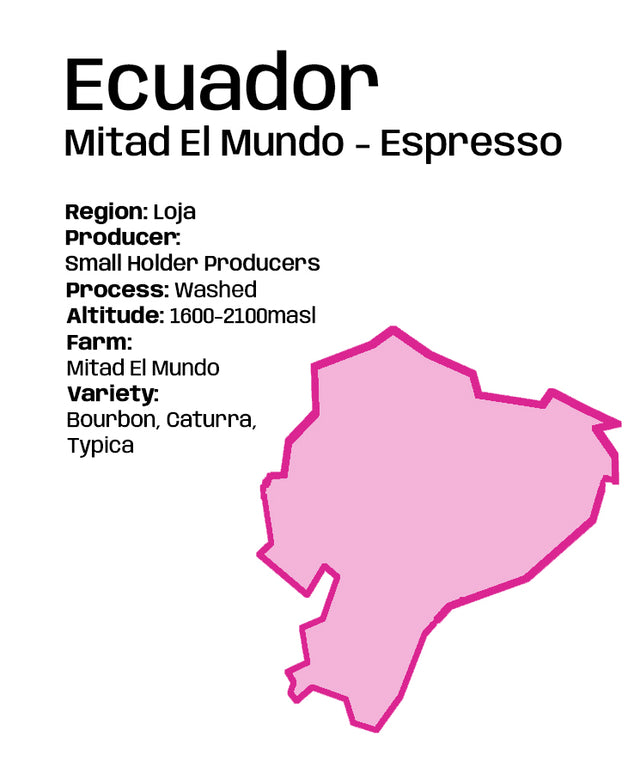
- Region: Loja
- Producer: Small holder producers
- Farm: Mitad El Mundo
- Importer: Caravela
- Price (green ex Shipping): £9.45p kg
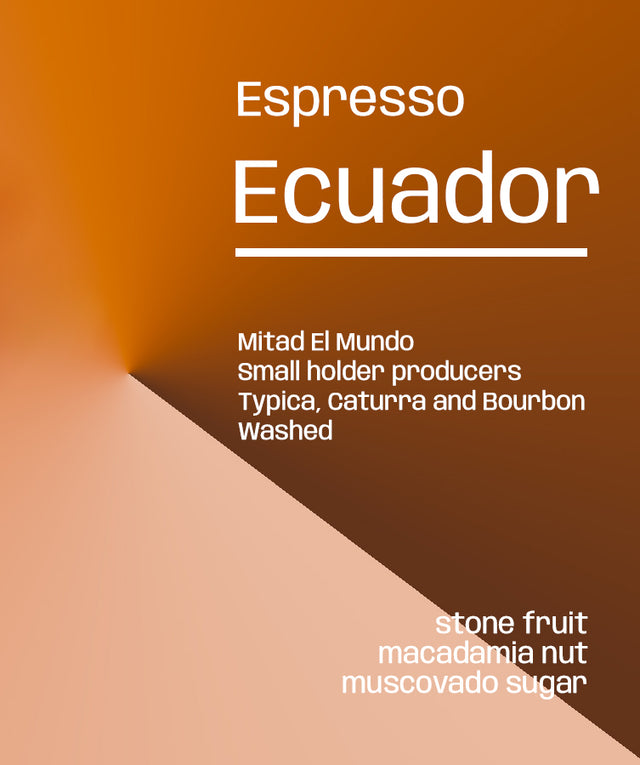
- Variety: Bourbon, Caturra, Typica
- Process: Washed
- Altitude: 1600-2100 MASL
- Amount Bought 276kg
- Tasting: Complex, Balanced, Full Body, Fruity
- Flavours like: Stone fruit, Macadamia nut, Muscovado sugar.