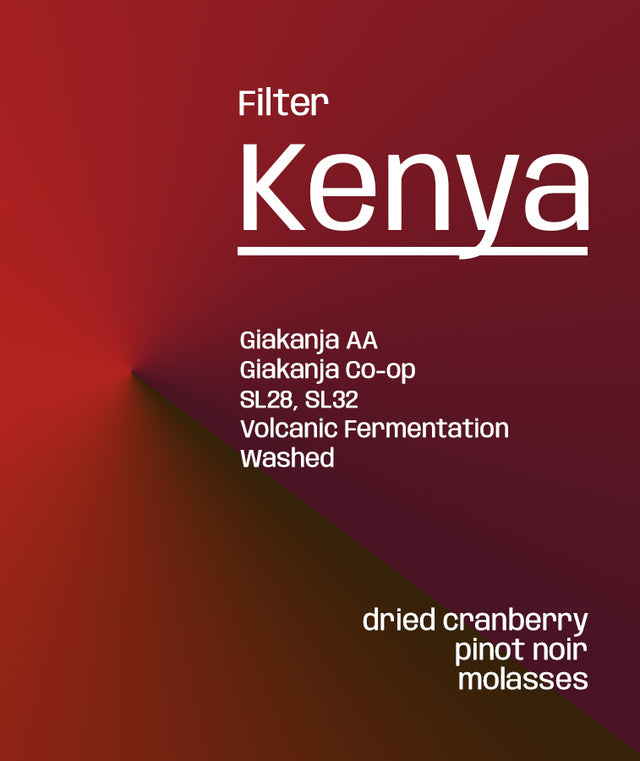
Kenya Giakanja AA - Filter
Kenya Giakanja AA - Filter
*****************************************************
• Producers + Mill:
Established in 1968 shortly after Kenya’s independence, the Giakanja Washing Station carries deep historical roots. The name originates from the
colonial era, when locals were organized into villages called Gichagi. The village leader was named Kanja, leading to the name Gichagi gia Kanja—meaning "the village belonging to Kanja." After independence, the community preserved this identity, naming both their village and their cooperative society Giakanja.
The washing station is located in Nyeri County, processing cherries from farms situated between 1,700 and 1,800 MASL. Nestled between the southern slopes of Mt. Kenya and the foothills of the Aberdare Range, the high elevation ensures a cool climate. This environment slows cherry
maturation, allowing for a higher concentration of sugars and a more complex flavor profile.
Farmers primarily grow traditional SL varieties, which are world-renowned for their superior cup quality and vibrant acidity.
******************************************************
• Varieties:
SL28 & SL34
Scott Laboratories – or Scott Labs – was established during British colonial rule of Kenya in the 1920s.Set up as an agricultural research centre, its role was to improve farming practices through technical advice and training on behalf of the Department of Agriculture.
Coffee, which was already integral to the Kenyan economy, quickly became the chief focus. In particular, researchers were keen to explore varieties that could offer long-term benefits, such as high yields and resistance to droughts and pests.
The idea was that they could distribute these varieties to farmers, who would then plant them on a commercial scale.
Together with the Lyamungo Research Station in Tanganyika (now Tanzania), they selected 42 different coffee trees to study.
SL28 was identified on a single tree in Tanzania and soon became ubiquitous thanks to its drought-resistance, high yield, and desirable cup profile. Since then, it has spread to other coffee-growing origins, including Uganda and Central America.
SL34 is also part of the Bourbon-Typica family and has adapted to grow in high altitude areas with a good amount of rainfall.
The variety was a single tree found on the private land of Loresho Estate in Kabete, Kenya. This tree was labelled “French Mission”, after its historical ties with French missionaries who had distributed original Bourbon seeds from the island of Réunion.
Both varieties are known for their exceptional quality and high yields. However, they are also recognised for susceptibility to diseases, such as coffee leaf rust and coffee berry disease
******************************************************
• Process:
Cherries are meticulously hand-picked at peak ripeness. Only the deep red cherries are delivered to the station, ensuring a uniform and high-quality
fermentation process. Then, cherries are sorted and floated. Pulping occurs in the evening. The coffee undergoes an initial 20-hour dry fermentation. After fermentation, the parchment is washed to remove the mucilage.
The coffee is held for an additional 24 to 26 hours in fermentation tanks before the final washing. The parchment is transferred to raised beds, where it is carefully dried until it reaches a stable moisture content of 10%.
******************************************************
• Region: Nyeri
• Producer: Small holder producers
• Farm: Giakanja
• Importer: Cofinet
• Price (green ex Shipping): £ 13.60pkg
• Variety: Sl28 & SL34
• Process: Washed
• Altitude: 1700-1800masl
• Amount Bought:60kg
• Tasting: Fruity, Complex, High Acidity, High Sweetness
• Flavours like: Dried cranberry, pinot noir, molasses.
Manage Subscriptions
Log in here to manage your current Lucid subscription!