


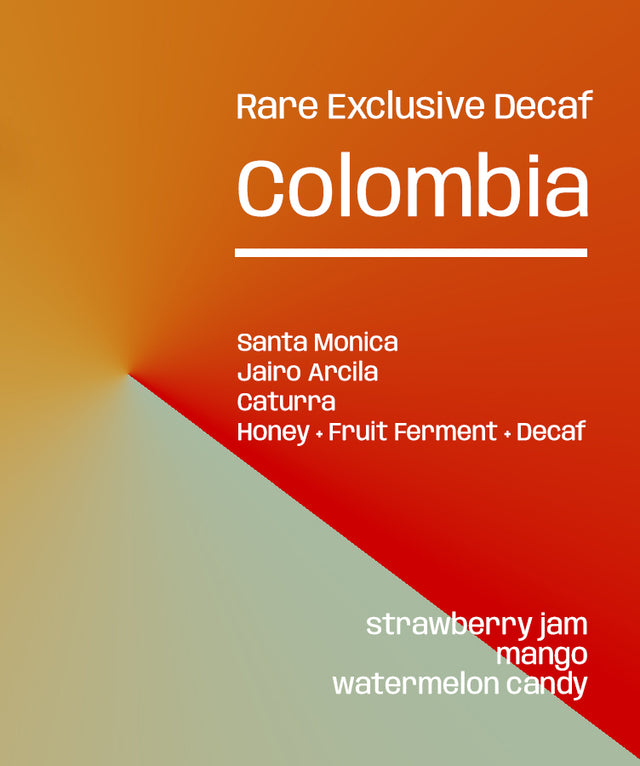
Colombia Santa Monica Fruit bomb Decaf - Rare/Exclusive Decaf filter
Colombia Santa Monica Fruit bomb Decaf - Rare/Exclusive Decaf filter
******************************************************
- Producers + Mill:
Jairo Arcila is a third-generation coffee grower from Quindio, Colombia. He is married to Luz Helena Salazar and they have two children together, Carlos and Felipe Arcila, who are the cofounders of Cofinet. Jairo’s first job was at Colombia’s second largest exporter, working as their Mill Manager for over 40 years until his retirement in 2019.
Jairo bought his first coffee farm, Finca La Esmeralda, in 1987 and this is where he planted his first Caturra lot. He was fortunate enough to earn money by producing coffee on his farm in addition to working full time. Using his savings, Jairo slowly managed to purchase five additional farms. After Esmeralda came Villarazo, Mazatlan, Santa Monica, Maracay and then Buenos Aires. Now, during the harvest period, Jairo can provide jobs to the locals generating an economic impact in the community.
He received great insight and expertise from his sons’ in the picking, sorting, and processing of his coffees. This insight has empowered Jairo and given him the tools needed to showcase fantastic coffees with amazing profiles from the region.
******************************************************
- Varieties:
Caturra emerged as a spontaneous mutation of Red Bourbon discovered in Minas Gerais in Brazil sometime between 1915 and 1918. Unlike Bourbon, which can grow tall and has sprawling branches, Caturra is a dwarf variety, characterized by its shorter stature and dense branching. This compact growth habit is due to a genetic mutation that causes the plant to produce less of the hormone responsible for vertical growth. As a result, Caturra trees are easier to maintain and harvest, making them a practical choice for farmers. The name ³Caturra´ comes from the Guarani word meaning ³small,´ a fitting tribute to its diminutive size. Despite its small stature, Caturra has had a massive impact on the coffee industry, particularly in Latin America, where it has become a staple of coffee farming.
Caturra¶s compact size allows farmers to plant more trees per hectare compared to taller varieties like Bourbon. This higher density, combined with its ability to produce more cherries, results in greater yields, making it an economically attractive option for growers.
While it is more resistant to some diseases than Bourbon, Caturra is still vulnerable to coffee leaf rust and other pests, which has led to the development of newer hybrid varieties like Castillo. Caturra thrives in a range of altitudes, from 800 to 1,600 m.a.s.l., making it versatile
for different growing regions. However, it truly shines at higher elevations, where cooler temperatures and rich soils enhance its flavour complexity. In Colombia, Caturra was once estimated to account for nearly half of the country's coffee production. This changed significantly after 2008, when a nationwide program to combat coffee leaf rust incentivized farmers to replace over three billion coffee trees with the rustresistant Castillo variety, which has Caturra in its genetic lineage. Common flavour descriptors include citrus, red berries, stone fruits, and hints of caramel or chocolate.
******************************************************
- Process:
For this lot, only the ripest cherries were harvested. The cherries are transported to our La Pradera processing center in grain pro bags or special tanks to preserve their freshness. Once cherries arrive in La Pradera, the cherries are floated in water tanks to remove any lowdensity beans or foreign materials. The water used in this stage is recycled for additional batches and, once no longer suitable for use, is filtered through a series of specialized tanks before being irrigated into vetiver grass beds and released as oxygen. This sustainable filtration system ensures that no contaminated water is discharged, maintaining our commitment to environmentally friendly practices.
Then, the cherries undergo a dry anaerobic fermentation process for 72 hours with the pulp on. During this stage, ripe strawberries and grapes are added to the fermentation tanks. The strawberries transfer their sweet, jammy flavors, while the grapes add bright and fruity
complexity to the coffee.
By fermenting coffee cherries alongside strawberries and grapes, we unlock an intense fruit profile that gives this ³Fruit Bomb´ its name: think ripe strawberries, blueberry and a sweet, vanilla-like honeyed finish.
Following fermentation, the cherries are pulped to remove the outer skin while leaving the mucilage intact. This sticky, honey-like layer is what gives the Honey process its name and contributes to the coffee¶s sweetness and body.
The pulped cherries are then transferred to our concrete patio or Elbas in Spanish, where they are spread evenly in thin layers. The cherries are carefully monitored and turned regularly to achieve uniform drying and to prevent over-fermentation or mold.
Drying continues until the cherries reach an ideal moisture content of 9.5%-11%, which is the perfect point for us.
Decaf Process -
Once our coffee beans are perfectly milled and sorted, they are transported to a specialized Decaffeination Center. Our decaf coffee undergoes the sugarcane ethyl acetate (EA) process, a method that not only enhances the coffee¶s natural sweetness but also preserves its
distinctive flavor profile. The process begins with green coffee beans being placed in a steam chamber, where they are exposed to steam. This gently removes the silver skin, a thin outer layer surrounding the bean. By opening the beans¶ pores, this step prepares them for decaffeination, making them more receptive to the subsequent stages.
After steaming, the beans are submerged in spring water to ensure full saturation, a critical step that readies them for caffeine extraction.
Once saturated, the beans are transferred to extractor chambers, where they come into direct contact with sugarcane-derived ethyl acetate (EA). EA is a naturally occurring compound found in sugarcane and other fruits, known for its effectiveness in dissolving caffeine. The EA
selectively binds to and removes caffeine molecules while leaving most of the coffee¶s flavor compounds intact, preserving the original taste and aroma. This phase can take up to eight hours.
After caffeine extraction, the decaffeinated beans are carefully dried in a controlled chamber. This step is crucial for restoring the beans to their optimal moisture content, maintaining their structural integrity, and preparing them for roasting. The drying process is meticulously
monitored to prevent over-drying, which could compromise quality.
******************************************************
- Region: Armenia, Quindio
- Producer: Jairo Arcila
- Farm: Santa Monica
- Importer: Cofinet
- Price (green ex Shipping): £21.50p kg
- Variety: Caturra
- Process: Honey + Fruit Ferment + Decaf
- Altitude: 1450 – 1500 masl
- Amount Bought: 48kg
Tasting: Wild, Funky, Tropical, Super Sweet
Flavours: Strawberry Jam, Mango, Watermelon Candy
Manage Subscriptions
Log in here to manage your current Lucid subscription!

